Animal Face Types Explained: Find Your Cat, Dog, Deer, Rabbit, Fox or Mixed Animal Look Alike
A practical guide to animal face type meanings, the visual clues behind each archetype, and how to connect your self-check with a photo-based Animal Face Test.

Editorial Note
This article is written for cultural understanding and entertainment-focused self-description. Animal face types are not a scientific diagnosis, beauty ranking, or fixed label. Most people overlap across more than one archetype, and makeup, expression, lighting, and camera angle can shift the impression.
Quick Takeaways
- Animal face types are a beauty-language trend, not a medical or scientific framework.
- The most repeated English-language archetypes are puppy or dog, cat, deer or fawn, rabbit or bunny, and fox.
- These labels usually describe eye shape, jawline, face length, nose shape, and the overall feeling a face gives off.
- You do not need to fit one type perfectly. Mixed types are normal and often more realistic than a single neat label.
- An AI photo test is most useful after you already understand the clues you are looking for.
- If your goal is simply to answer “what animal do I look like?”, use the homepage test after reading the checklist and compare the percentage spread, not only the top label.
In This Guide
When people search animal face types, they are usually looking for a practical vocabulary of animal face archetypes, not a scientific label. The goal is to describe why one face feels feline and sharp, another warm and puppy-like, and another bright, delicate, or deer-like.
In Korean beauty culture and the broader English-language internet that now borrows from it, these animal labels work like shorthand. Instead of listing ten separate features, people say cat face, puppy face, deer face, rabbit face, or fox face. A whole mood arrives at once. You picture the eyes first, then the jawline, then the energy of the person. It is playful, memorable, and surprisingly sticky from an SEO point of view because the phrase answers a very human question: what do I look like?
After reviewing current explainers and commentary published through March 19, 2026, one pattern stood out to me: there is no single universal master list. The core ideas repeat, but the number of archetypes changes from article to article. That is why this guide does two things at once. First, it explains the classic animal face types readers already recognize. Then it shows how to think about those archetypes inside a broader system, including the expanded 9-animal model used on our Animal Face Test. If you already know the basic labels and want a practical checklist, start with our Korean animal face type self-check guide.
What Are Animal Face Types?
Animal face types are a style-based way of describing facial resemblance through archetypes rather than measurements alone. Instead of saying someone has moderately upturned almond eyes, a narrow lower face, and defined cheekbones, people might simply say she has a cat face. The animal label compresses several visual cues into one image that feels easy to remember and easy to share. For a deeper single-type breakdown, see the cat face type guide.
That shorthand matters because beauty language is rarely purely technical. Real people do not walk around discussing interpupillary distance at brunch. They talk in impressions: soft, sharp, sweet, cool, bright, mysterious, innocent, elegant. Animal face types are really a bridge between those emotional impressions and the physical features that create them.
Across the sources I reviewed, the recurring clues were eye shape, brow direction, jawline softness or sharpness, face length versus roundness, cheek fullness, and nose shape. Some articles also mention lips, lashes, or neck length. In other words, this trend is less about one isolated feature and more about harmony. A puppy face is not just round eyes. A cat face is not just an upturned corner. The type emerges when multiple cues lean in the same direction.
The most useful way to think about animal face types is as a descriptive lens. It can help you understand why certain makeup styles flatter you, why some celebrity comparisons feel right, and why your face reads differently in different photos. What it should not become is a rigid identity test. A face is a living thing. Expression, haircut, makeup, and camera angle all change the story.
- Use the labels as visual shorthand, not objective truth.
- Expect overlap, especially between neighboring types such as cat and fox or rabbit and puppy.
- Treat the result as a style clue that can guide makeup, photos, and self-description.
Why Korean Beauty Talks About Faces This Way
If you feel as if animal face types appeared out of nowhere in English beauty content, that is only half true. The labels have been circulating in Korean popular culture for years, especially in entertainment coverage, idol discourse, beauty chatter, and everyday conversations about first impressions. English-language readers are encountering a translated version of a much older habit: describing a face through animal resemblance because it feels intuitive and emotionally legible.
For the broad cultural backdrop, even the mainstream Wikipedia overview of K-beauty shows how far Korean beauty language, product culture, and trend vocabulary have traveled globally. Once beauty trends move internationally, the descriptive language moves with them. Animal face types are one of those sticky terms that jumped from local shorthand into global search behavior.
A 2025 Korea Times discussion of the so-called K-face captured something I also saw repeated in lighter beauty explainers: labels like cat face and dog face do not just name anatomy, they hint at social feeling. Cat face often signals sharper, cooler, more polished energy. Dog or puppy face often signals warmth, friendliness, and openness. In other words, these terms live at the meeting point of structure and personality projection.
In Korean beauty culture, animal face types work as memorable shorthand for facial impressions. The labels connect eye shape, jawline, face length, and overall mood, so a reader can understand a cat, dog, deer, rabbit, or fox archetype quickly. They remain style language rather than a fixed identity.
The language around animal face types works because it turns facial structure into a story people can picture immediately.
The Classic Animal Face Archetypes
These are the five archetypes that appeared most consistently across the English-language sources reviewed for this guide.
When I compared explainers side by side, five types kept reappearing: puppy or dog, cat, deer or fawn, rabbit or bunny, and fox. Different writers use slightly different feature lists, but the emotional center of each type is remarkably stable. That consistency is useful because it gives us a common baseline before we move into more expanded systems.
The descriptions below are not meant as strict rules. Think of them as cluster patterns. If several traits in one card sound familiar, that archetype may be a strong match for you. If two cards feel equally right, you are probably a mixed type, which is extremely common.
Puppy or Dog Face
Puppy face is the archetype of softness, warmth, and easy approachability. It usually reads youthful and emotionally open rather than severe or dramatic.
- Signature features: round or droopy eyes, straighter brows, softer jawline, fuller cheeks, rounder nose, gentler lower face
- Overall impression: friendly, sweet, cheerful, loyal, innocent
- Often confused with: rabbit when the cheeks are especially youthful, or deer when the eyes are large but the face is longer
Cat Face
Cat face is crisp, polished, and a little cooler in tone. The lines are usually cleaner, sharper, and more lifted than in the puppy archetype.
- Signature features: almond or slightly upturned eyes, more angular jawline, stronger cheekbone definition, narrower lower face, smaller or sharper nose
- Overall impression: chic, poised, charismatic, sleek, slightly aloof
- Often confused with: fox when the eyes become longer and more slanted, or tiger when the features feel stronger and more powerful
Deer or Fawn Face
Deer face is delicate and graceful. It tends to center on large gentle eyes and an overall impression of softness with length rather than roundness.
- Signature features: big bright eyes, longer face, slimmer jawline, lighter features, long lashes, refined proportions
- Overall impression: gentle, airy, elegant, innocent, quietly luminous
- Often confused with: rabbit when the face is shorter and cuter, or puppy when the energy is warmer and rounder
Rabbit or Bunny Face
Rabbit face is youthful, bright, and often a bit more energetic than deer face. The cuteness is front and center, especially around the eyes and cheeks.
- Signature features: round eyes, baby-face proportions, softer cheeks, smaller nose, lively expression, a sweeter lower face
- Overall impression: cute, bubbly, lovable, fresh, playful
- Often confused with: puppy when the face reads warmer than doll-like, or deer when the eyes are large but the face is more elongated
Fox Face
Fox face is the elegant cousin of cat face. It usually feels longer, slimmer, and a little more mysterious than the cat archetype.
- Signature features: longer upturned eyes, pointed or straighter nose, narrow face, sharper chin, cleaner lines, less cheek softness
- Overall impression: sultry, refined, clever, mature, composed
- Often confused with: cat when the face is less elongated, or snake-like extended archetypes in beauty communities that use a broader list
A Side-by-Side Comparison You Can Actually Use
A good comparison table should not drown you in niche detail. The goal is to make quick distinctions easier. When readers get stuck, it is usually because two archetypes share one or two traits. A table helps you spot the difference in the overall pattern.
If you only remember one thing from this section, remember this: eye shape starts the conversation, but face length, jawline, and cheek fullness usually decide the final call.
| Type | Fastest visual clue | Face shape tendency | Overall mood | Usually confused with |
|---|---|---|---|---|
| Puppy or Dog | Rounder or droopier eyes | Soft, rounded, approachable | Warm and friendly | Rabbit, Deer |
| Cat | Almond or slightly lifted eyes | Sharper lower face | Chic and polished | Fox, Tiger |
| Deer or Fawn | Large gentle eyes | Longer and slimmer | Graceful and delicate | Rabbit, Puppy |
| Rabbit or Bunny | Cute bright eyes and youthful cheeks | Shorter, softer, baby-face | Bubbly and sweet | Puppy, Deer |
| Fox | Longer lifted eyes with a narrow face | Slim and pointed | Elegant and mysterious | Cat |
How to Find Your Animal Face Type Without Overthinking It
When people misclassify themselves, it is usually because they start with a favorite label instead of a neutral checklist. The better method is to look at your face in a plain, front-facing photo with relaxed expression and soft light. Then move through the features in order: eyes, brows, face length, jawline, cheeks, and nose. This gives you something more stable than a passing mood or a heavily filtered selfie.
Start with the eyes because they carry the strongest archetype signal. Are they rounder and open, long and lifted, or large and gentle? Then look at the frame around them. Straight brows often reinforce puppy softness, while more arched or lifted lines can support cat or fox energy. Big eyes alone do not equal deer or rabbit; the surrounding structure decides which direction they lean.
Next, compare face length and roundness. A longer, slimmer silhouette often pushes the impression toward deer or fox. A shorter, softer silhouette often pushes it toward rabbit or puppy. After that, look at the jawline. Sharpness generally strengthens cat or fox. Softness generally supports puppy or rabbit. Finally, use cheeks and nose as tie-breakers. Fuller cheeks can make a face read sweeter and younger, while a cleaner, more pointed lower face can make the same eyes feel more mature and refined.
If you want a practical rule, choose the archetype that explains the most features at once, not just the one with the prettiest name. The right label usually feels clarifying, not forced. It should make your makeup choices, photo impressions, and style references click into place.
| Feature to check | If you mostly see this | Likely direction |
|---|---|---|
| Eye shape | Round, open, slightly droopy | Puppy or Rabbit |
| Eye shape | Almond, lifted, more defined outer corner | Cat or Fox |
| Face length | Longer and slender | Deer or Fox |
| Face length | Shorter and softer | Rabbit or Puppy |
| Jawline | Soft and rounded | Puppy, Rabbit |
| Jawline | Sharper and narrower | Cat, Fox |
Why So Many People Fit More Than One Type
Mixed results are not a flaw in the framework. They are the framework working honestly. Most faces are not built like icons in a sticker pack. A person can have cat-like eyes, deer-like delicacy, and rabbit-like cheeks all at once. The reason people feel confused is that internet content often presents animal face types as clean boxes, while real faces behave more like gradients.
There is also a strong styling effect. A straighter brow and glossy lip can pull someone toward puppy softness. Winged liner and lifted contour can shift the same face toward cat or fox. Hair matters too. Full bangs can enhance youthful rabbit energy, while a sleek center part can sharpen the impression toward cat or deer depending on the face underneath.
The camera adds another layer. Smartphone distortion, focal length, head tilt, and smile intensity all change the visual story. That is why I always tell readers to look at three or four plain photos before deciding. If one archetype appears in every image, that is probably your base type. If two keep alternating, you are likely a hybrid.
- Cat plus deer is common when the eyes are large but the face still feels refined.
- Puppy plus rabbit is common when the face is soft, cute, and friendly at the same time.
- Cat plus fox is common when the features are sharp but the face also reads longer and narrower.
- Deer plus rabbit is common when the eyes are big and bright, but the face sits between delicate and youthful.
Where an AI Animal Face Test Can Help
An AI test is most useful after you understand the archetypes well enough to ask better questions. Instead of treating the tool as magic, use it as a second opinion. If you already suspect you are somewhere between cat and fox, or between rabbit and puppy, a structured feature analysis can help you see which traits dominate in a neutral photo.
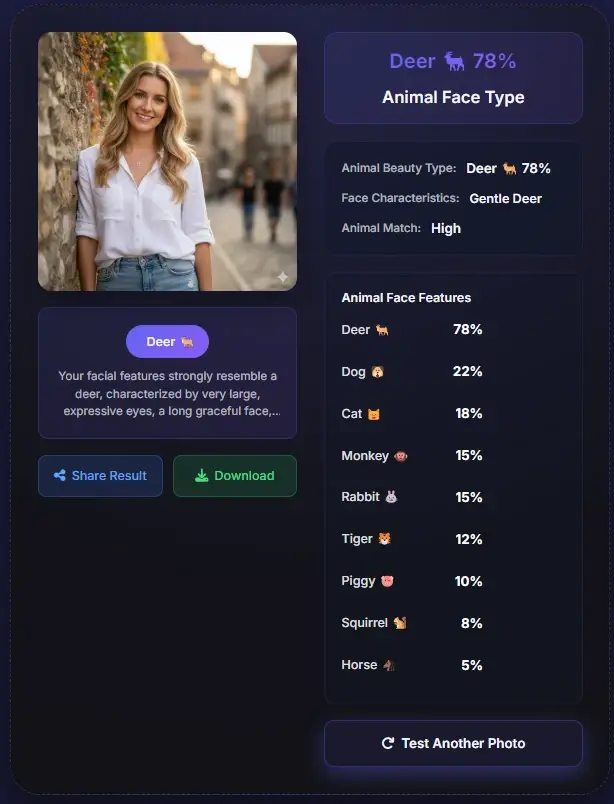
Readers who arrive from “animal look alike” searches usually want a practical answer, not only definitions. A good photo-based animal face test should explain the match in crawlable text, show secondary percentages, and make clear that the result is a style interpretation rather than a fixed identity.
That is especially helpful because people are rarely objective about their own faces. We get attached to one feature and ignore the rest. An AI model, by contrast, can compare several signals at once: face length, eye geometry, balance of softness versus sharpness, cheek fullness, and overall proportions. The output is still interpretive, but it can be more systematic than guessing based on mood.
On our Animal Face Test, the value is not only the top match. The percentage spread matters too. If your top score is cat but deer and fox also rank highly, that tells a richer story than a single label ever could. It suggests your face has a polished base with softer or more elongated secondary cues. That kind of nuance is much closer to how people actually look in real life.
A practical tip from experience: upload one clear, front-facing photo first. Use natural light, keep your expression relaxed, and remove anything that hides the brow or jawline. Once you have your baseline result, you can experiment with different photos to see which features stay constant and which ones shift with styling.
- Use one neutral photo for your first result.
- Read the secondary matches, not just the top match.
- Compare the output with the checklist in this article instead of treating the score as a final verdict.
- If you want to understand how the product works, you can also read our About page for a high-level overview of the analysis approach.
Accuracy, Limits, and the Trust Question
If we want this article to be genuinely useful, we have to say the quiet part clearly: animal face types are not objective truth. They are pattern-based beauty language. That does not make them useless. It just means they belong in the same category as style archetypes, seasonal palettes, and face-shape guides - helpful when used lightly, misleading when used too literally.
This is where trust matters. A good article should tell you what the framework can do and what it cannot. It can help you notice recurring visual signals. It can help you explain why one makeup mood suits you better than another. It can help you search for references more intelligently. What it cannot do is tell you your worth, predict how every person will read your face, or flatten a living face into a single permanent identity.
The same principle applies to AI tools. A trustworthy tool should explain that photo quality affects results, that overlap is normal, and that privacy matters. If you upload face images anywhere online, read the policy first. On our side, we encourage readers to review the Privacy Policy before using any face-analysis feature so the experience stays informed, not passive.
EEAT-friendly content is not content that sounds stiff or self-important. It is content that is honest about evidence, transparent about method, careful with claims, and useful to readers in the moment they searched. That is the bar this guide is trying to meet. For a closer look at how visual labels differ from claims about personality, read our animal face personality vs face type guide.
Classic Archetypes vs Our Broader 9-Animal System
One useful insight from this research is that the English web tends to stop at the classic, easy-to-explain archetypes. That is good for readability, but it leaves out the finer distinctions many users actually care about. Our site uses a broader 9-animal model because some faces do not sit comfortably inside only five buckets. A face can feel stronger than cat, more playful than rabbit, or softer than fox without becoming any of those archetypes exactly.
This expanded view lets the result page do something more realistic: it shows your primary type while still preserving the neighboring signals. That is why readers searching "what animal do I look like" often respond better to a percentage-based output than a single rigid label. It feels closer to how people compare faces in real life: not identical to one animal, but closer to one cluster than another.
Think of the classic archetypes as your vocabulary foundation and the 9-animal system as the higher-resolution map. The classic set helps you understand the language. The broader set helps you interpret nuance.
| Classic beauty-language type | Closest match in our 9-animal model | Why the broader system helps |
|---|---|---|
| Cat | Cat, Tiger | Separates sleek sharpness from stronger, more intense facial power |
| Puppy or Dog | Dog, Piggy | Distinguishes friendly warmth from extra softness and roundness |
| Deer or Fawn | Deer, Horse | Captures the difference between delicate gentleness and longer elegant length |
| Rabbit or Bunny | Rabbit, Squirrel | Helps separate doll-like cuteness from smaller, lighter, more delicate features |
| Fox | Cat, Tiger, Horse | Lets you see whether the impression comes more from sharpness, intensity, or elongated elegance |
| Playful or mischievous mixed types | Monkey | Adds a category for expressive, animated, less conventional facial energy |
Animal Look Alike vs Animal Face Type Test
Searches such as animal look alike, what animal do I look like app, and animal face type test sound similar, but they are not always asking for the same experience. An animal look alike search usually wants a quick photo-based answer. An animal face type search usually wants the explanation behind that answer: which facial cues created the match and why another person might describe the same face differently.
If you came here from an app-style query, read the comparison table first, then run the Animal Face Test. If you came from a definition query, stay with the archetype sections and use the test only after you understand the difference between cat, fox, deer, rabbit, puppy, and mixed types.
| Intent | Best page | Reason |
|---|---|---|
| Photo answer | Animal Face Test | Upload a portrait and get animal look alike percentages. |
| Korean labels | Korean Animal Face Types Test | Focuses on puppy, cat, deer, rabbit, and fox face language. |
| Definitions | This guide | Explains meanings, examples, overlap, and limitations. |
How to Use This Guide for What Animal Do I Look Like Searches
If your search is what animal do I look like, use this guide as the interpretation layer before or after the Animal Face Test. The tool shows primary and secondary percentages; this page explains the animal face archetypes behind those labels.
For example, a cat result with a strong fox score usually means the tool sees lifted or sharper cues. A deer result with rabbit overlap usually means the eyes and softness are strong, but the face may sit between graceful and cute. Reading the result this way is more useful than treating one percentage as a fixed identity.
- Use the AI photo animal face test when you want a fast animal look alike answer.
- Use the animal face type quiz when you want a focused face representative animal quiz experience.
- Use the Korean animal face types test when you care most about puppy, cat, deer, rabbit, and fox face language.
Ready to Test Your Animal Look Alike?
Understand the animal face archetypes first, then upload one clear photo to compare your strongest type with the secondary percentage matches.
Frequently Asked Questions
References and Further Reading
-
The Korea Times - 'Do you have a K-face?'Used for cultural context around cat face and dog face language in Korean appearance talk.Open source
-
Wikipedia - K-beautyUsed only as a broad background reference for the international spread of K-beauty vocabulary and trends.Open source
-
ONLYOU Korean Language SchoolReviewed for recurring feature descriptions across dog, cat, deer, rabbit, and fox style archetypes.
-
The YesStylist / YesStyleReviewed for beauty-language framing and makeup-oriented interpretations of animal face types.
-
Daily VanityReviewed for quiz-style framing and additional examples of extended archetypes.
-
Animal Face Test internal materialsReviewed to align the article with the site's expanded 9-animal model and on-site user intent.