Upload one neutral selfie
Start with a front-facing photo in even light. The cleaner the photo, the easier it is to judge the exact balance between round eyes, lifted eyes, face length, cheek fullness, and jawline shape.
Upload a clear selfie and find out whether your features read more like puppy face, cat face, deer face, rabbit face, or fox face. This Korean animal face types test is built for the beauty-language people actually search for, with AI analysis focused on eye shape, face length, jawline, cheeks, and overall vibe.
Use a clear front-facing selfie, or drag and drop your image here
Best results come from natural light, a relaxed expression, and a full view of your eyes, nose, cheeks, and jawline.
This Korean animal face types test focuses on the visual signals people usually mean when they compare a face to puppy, cat, deer, rabbit, or fox.


Start with a front-facing photo in even light. The cleaner the photo, the easier it is to judge the exact balance between round eyes, lifted eyes, face length, cheek fullness, and jawline shape.
The test looks at the same high-intent signals people use in Korean animal face type quizzes: eye shape, brow direction, nose line, cheek volume, lower-face softness, and whether your face reads short and cute or long and refined.
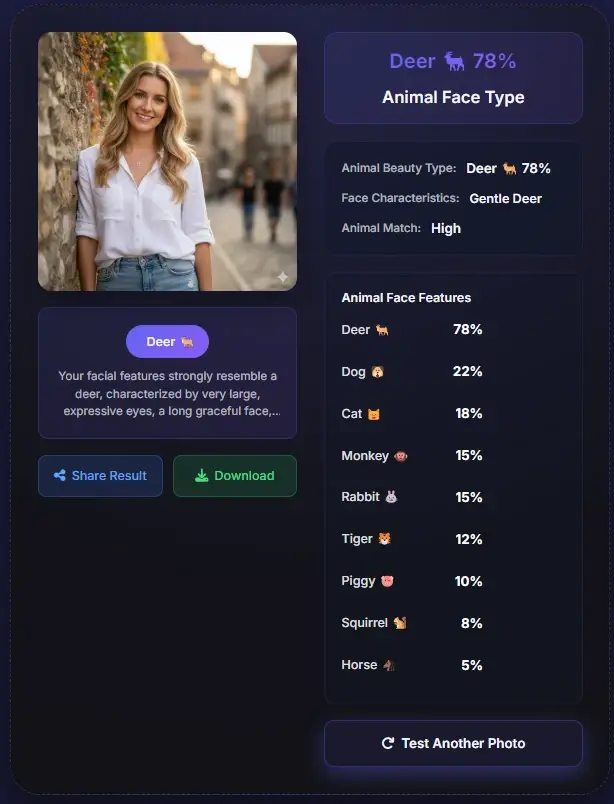
Instead of forcing one label too early, the page shows your top Korean animal face type plus nearby secondary matches. That makes it easier to understand why you might read as cat and fox, or deer and rabbit, at the same time.
A good Korean animal face types test should make the upload workflow clear before you trust the result.
Start with one front-facing portrait in natural light. Avoid heavy filters, extreme angles, sunglasses, or hair covering your eyes and jawline.
Use the test for entertainment and self-description. Review the privacy policy before uploading if you want to understand the photo-analysis workflow.
Puppy, cat, deer, rabbit, and fox face are cultural style labels, not medical or scientific categories. Use the percentage spread as a guide, not a verdict.
Most English searches around Korean animal face types are really asking about five recurring archetypes. These are the categories this page treats as the core set because they show up most often in beauty explainers, quizzes, and user questions.
Puppy face is warm, soft, and approachable. In Korean animal face type language, it usually means a face with kind eye energy, softer contours, and a naturally friendly first impression rather than dramatic sharpness.
Cat face is one of the most searched Korean animal face types because it feels instantly recognizable. It usually centers on sharper lines, a more pointed lower face, and eyes that look narrower, lifted, or more defined at the outer corners.
Deer face sits on the delicate and graceful side of Korean animal face types. People usually mean bright gentle eyes, a longer line through the face, and a refined softness that feels airy rather than childish.
Rabbit face is the cute, bright, doll-like end of the spectrum. In a Korean animal face types test, rabbit usually comes through when a face feels youthful and soft, with rounded visual cues instead of elongated elegance.
Fox face is usually searched by people deciding whether they lean more cat or something sharper and more mature. It keeps the lifted-eye energy of cat face, but often adds longer, slimmer, more directional features.
People rarely search for Korean animal face types because they want a dictionary definition only. Most want help with a real decision, like whether they lean cat or fox, or whether their large eyes read more deer or rabbit.
Both types can have lifted or sharper eyes, so the difference usually comes from the total face shape. Cat face reads tighter and more compact. Fox face usually feels narrower, longer, and more directional.
These two get confused constantly because both can feature large attractive eyes. The simplest way to separate them is to ask whether your face reads graceful and elongated or cute and compact.
If you are deciding between cat and fox, rabbit and puppy, or deer and rabbit, read the full 5-step self-check guide before uploading a new photo.
Read the self-check guideOne reason people keep searching for Korean animal face types instead of stopping after one quiz is that real faces are mixed. You can have cat-like eyes, rabbit-like cheeks, and a deer-like silhouette in the same photo.
That overlap is normal, and it is one reason this page is built to show nearby matches instead of only one hard label. A single selfie can also exaggerate one side of your face language. Makeup, bangs, lash styling, and camera distance all change the final read.
The most useful way to use the result is to treat the top type as your base archetype and the second type as the clue that explains why some people describe you differently. That is especially common with cat-plus-fox, deer-plus-rabbit, and puppy-plus-rabbit combinations.
Some Korean animal face types tests and beauty articles expand the list beyond the core five. These labels can be useful, but they work best as secondary categories rather than the main framework for a first-time visitor.
Bird face usually refers to a smaller-looking head, a slender nose, and features that pull visual attention toward the center of the face. It often overlaps with fox or deer depending on length and softness.
Pig face usually sits on the very cute side of the spectrum, with round cheeks, soft contours, and a fleshy or more button-like nose. It tends to overlap with rabbit or puppy types.
These show up on broader East Asian beauty sites when the face feels more angular, unusual, or strongly directional. They are useful as long-tail descriptors, but less central than puppy, cat, deer, rabbit, and fox.
The most common Korean animal face types people talk about online are puppy face, cat face, deer face, rabbit face, and fox face. Different quizzes may expand the list, but those five are the core set most readers recognize.
Usually yes. In English-language beauty content, puppy face and dog face are often used interchangeably to describe warm, soft, approachable features with rounder or gently drooping eyes.
Cat face is usually sharper and more compact, while fox face usually feels longer, narrower, and more mature. If the entire face is slim and directional, fox is often the better fit.
Both can have large eyes, but deer face is typically longer and more graceful, while rabbit face is shorter, softer, and cuter. The easiest clue is whether your face reads elegant first or youthful first.
Yes. Many people are mixed types, which is why this Korean animal face types test shows nearby matches as well as a top result. Mixed signals are common in real faces.
No. Korean animal face types are best understood as beauty and pop-culture archetypes. They can be helpful for describing facial impressions, but they are not a medical or scientific classification system.
No. This test focuses on the five animal-face archetypes people search most often: puppy, cat, deer, rabbit, and fox. “16 face type” systems usually combine broader beauty or personality categories and follow a different intent, so they should not be treated as the same classification.